Retiring in 2027? The 2027 chart has the pension by rank with the new raise. See the 2027 retirement pay chart →
The 3.8% raise lifts a 2026 pension a little at first, and more for each month you serve after it. Below you'll find complete retirement pay charts for enlisted and officer ranks at the most common retirement points of 20, 24, 26 and 30 years of service.
All figures use the High-3 retirement system (50% of your highest 36-month average base pay at 20 years, plus 2.5% for each additional year). If you're under the Blended Retirement System (BRS), multiply these amounts by 0.80 for your pension portion (BRS uses a 2.0% multiplier instead of 2.5%). If you're under BRS, you also face a one-time choice at retirement, between a lump sum and the full annuity. Our BRS lump sum vs annuity guide runs the numbers.
Quick Reference. Find your rank in the charts below, then look across to your expected years of service. That's your estimated 2026 monthly retirement pay before taxes. Already retired? If you retired before 2025, your pay rose 2.8% with the December 2025 COLA. If you retired during 2025, your first COLA was smaller (see below).
How these figures are calculated. Each figure is a true High-3 pension. That's the average of the highest 36 months of base pay, built month by month from the official 2023 through 2026 DFAS tables, times the multiplier for your years of service, rounded down to the dollar the way DFAS pays it. It assumes you retire on July 1, 2026 after holding the listed rank for the last three years. Exact promotion and retirement dates shift the result slightly, so for your personal figure use the free retirement calculator.
Looking for active duty base pay instead? The complete 2026 military pay chart has the full DFAS table for every rank and year of service.
Download the 2026 pay chart (PDF)
A printable one-page chart with every retirement rank at 20, 24, 26 and 30 years. Free, no signup required.
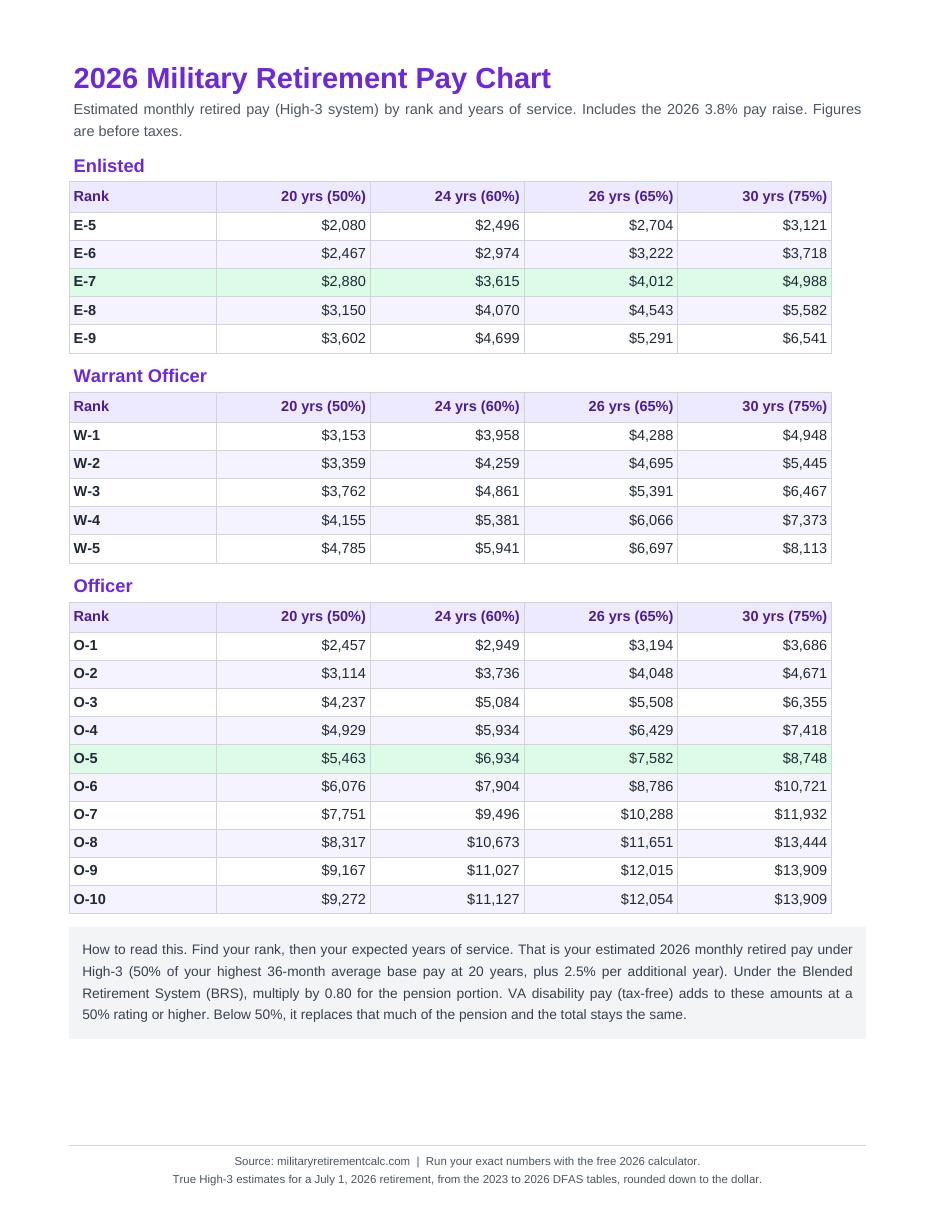
2026 Enlisted Retirement Pay Chart (High-3)
Monthly retirement pay for enlisted ranks E-5 through E-9. These are the ranks most commonly held at retirement-eligible years of service.
| Rank | 20 Years (50%) | 24 Years (60%) | 26 Years (65%) | 30 Years (75%) |
|---|---|---|---|---|
| E-5 (SGT/PO2) | $2,080 | $2,496 | $2,704 | $3,121 |
| E-6 (SSG/PO1) | $2,467 | $2,974 | $3,222 | $3,718 |
| E-7 (SFC/CPO) | $2,880 | $3,615 | $4,012 | $4,988 |
| E-8 (1SG/SCPO) | $3,150 | $4,070 | $4,543 | $5,582 |
| E-9 (SGM/MCPO) | $3,602 | $4,699 | $5,291 | $6,541 |
E-7 is highlighted because it's the most common retirement rank for enlisted members. At 20 years, you'd be paid $2,880/month ($34,560/year) before taxes. By 30 years, that jumps to $4,988/month ($59,856/year), an extra $25,296 per year for serving 10 more years. If you're retiring right at 20, military pension after 20 years works that E-7 through after tax and with VA disability.
Found your rank? That's the pre-tax number.
The figure in the table is before federal tax, before your state takes its cut, and before your VA rating either adds to it or swaps part of it for tax-free VA pay. Those three can move your real monthly income by hundreds of dollars, up or down. See your actual take-home for your rank, your state, and your rating.
See what you keep →2026 Officer Retirement Pay Chart (High-3)
Monthly retirement pay for officer ranks O-1 through O-10. Most officers retire between O-4 and O-6.
| Rank | 20 Years (50%) | 24 Years (60%) | 26 Years (65%) | 30 Years (75%) |
|---|---|---|---|---|
| O-1 (2LT/ENS) | $2,457 | $2,949 | $3,194 | $3,686 |
| O-2 (1LT/LTJG) | $3,114 | $3,736 | $4,048 | $4,671 |
| O-3 (CPT/LT) | $4,237 | $5,084 | $5,508 | $6,355 |
| O-4 (MAJ/LCDR) | $4,929 | $5,934 | $6,429 | $7,418 |
| O-5 (LTC/CDR) | $5,463 | $6,934 | $7,582 | $8,748 |
| O-6 (COL/CAPT) | $6,076 | $7,904 | $8,786 | $10,721 |
| O-7 (BG/RDML) | $7,751 | $9,496 | $10,288 | $11,932 |
| O-8 (MG/RADM) | $8,317 | $10,673 | $11,651 | $13,444 |
| O-9 (LTG/VADM) | $9,167 | $11,027 | $12,015 | $13,909 |
| O-10 (GEN/ADM) | $9,272 | $11,127 | $12,054 | $13,909 |
O-5 is highlighted because it sits in the middle of the O-4 to O-6 range where most officers retire. An O-5 at 20 years is paid $5,463/month ($65,556/year) before taxes.
2026 Warrant Officer Retirement Pay Chart (High-3)
| Rank | 20 Years (50%) | 24 Years (60%) | 26 Years (65%) | 30 Years (75%) |
|---|---|---|---|---|
| W-1 | $3,153 | $3,958 | $4,288 | $4,948 |
| W-2 | $3,359 | $4,259 | $4,695 | $5,445 |
| W-3 | $3,762 | $4,861 | $5,391 | $6,467 |
| W-4 | $4,155 | $5,381 | $6,066 | $7,373 |
| W-5 | $4,785 | $5,941 | $6,697 | $8,113 |
Where these numbers come from. Each figure is a High-3 pension. That's the average of the highest 36 months of basic pay, under 10 U.S.C. 1407, times 2.5% for each year served, under 10 U.S.C. 1409. The basic pay underneath is the DFAS pay tables for 2023 to 2026. Links to each are in the sources at the end.
How the 2026 Pay Raise Affects Your Retirement
The 2026 changes reach people still serving and people already retired in two different ways.
If You're Retiring in 2026 (New Retirees)
The 3.8% base pay raise increases the High-3 average used to calculate your pension. Your retirement pay is figured like this.
Years of Service × 2.5% × Average of Highest 36 Months Base Pay
The raise lifts it only a little at first, because the High-3 averages 36 months. Retire on July 1, 2026 and six of those months are on the 2026 table. That adds $19 a month to an E-7's pension at 20 years and $35 to an O-5's. Each month you stay past that swaps an older month for one at the new rates.
If You're Already Retired (COLA for Current Retirees)
If you retired before 2025, your check went up by the full 2.8% COLA (Cost of Living Adjustment) on December 1, 2025. It's automatic, no action needed. If you took the Career Status Bonus under REDUX, your COLA is a point lower, so yours was 1.8%. If you retired during 2025 under High-3 or BRS, your first COLA counted only the inflation since you retired, so it was 2.6% for January to March, 1.6% for April to June, 0.7% for July to September and nothing for October to December. The table below is the full 2.8%.
The 2027 COLA is 3.6%. See what it adds by rank. Retiring in 2026? Your first one is cut by quarter the same way, and the COLA trap works out what each retirement month pays.
| Your check before COLA | After the 2.8% COLA | Monthly Increase |
|---|---|---|
| $2,000/month | $2,056/month | +$56 |
| $3,000/month | $3,084/month | +$84 |
| $4,000/month | $4,112/month | +$112 |
| $5,000/month | $5,140/month | +$140 |
| $6,500/month | $6,682/month | +$182 |
BRS (Blended Retirement System) Pay Chart
If you joined the military on or after January 1, 2018 (or opted into BRS), your pension multiplier is 2.0% per year instead of 2.5%. That means 40% at 20 years instead of 50%. In return, the government puts up to 5% of your base pay into your TSP, 1% automatically and up to 4% more to match what you put in.
| Rank | High-3 (20 yrs) | BRS (20 yrs) | Difference |
|---|---|---|---|
| E-5 | $2,080 | $1,664 | -$416 |
| E-7 | $2,880 | $2,304 | -$576 |
| O-3 | $4,237 | $3,389 | -$848 |
| O-5 | $5,463 | $4,371 | -$1,092 |
BRS members. The pension is 20% smaller, and the TSP money is meant to make up for it. Here's how far it gets at 20 years. Say you put in 5% of base pay from your first month, the government adds its 1% after 60 days and its full 4% match after 2 years, you make E-5 at 4 years, E-6 at 8 and E-7 at 13, and you earn 5% a year over inflation. After 20 years on today's pay tables your TSP holds about $171,000 in today's dollars, and about $82,000 of that is the government's money. The smaller pension costs an E-7 $576 a month, and an income that size is worth $172,800 to $207,360 as a portfolio (25 to 30 times a year of it). So the government's share covers a little less than half of the cut, 40% to 48%. Count the minimum continuation pay too, 2.5 times a month's base pay at 12 years, invested the same way, and it covers about half, 49% to 58%. Your own 5% would be yours under either system. Weighing a Roth move on that balance? Our TSP Roth conversion guide covers the tax angle.
Retirement Pay + VA Disability: Total Monthly Income
Most military retirees also receive VA disability compensation. Here's the total for 2026 at 20 years, for a veteran alone with no dependents. At a 50% rating or higher, a 20-year retiree gets both checks in full under Concurrent Retirement and Disability Pay (CRDP), so the VA pay adds on top. Have a spouse or kids? Dependents raise these VA rates.
| Rank | Retirement (20 yrs) | + 50% VA | + 80% VA | + 100% VA |
|---|---|---|---|---|
| E-5 | $2,080 | $3,213 | $4,182 | $6,019 |
| E-7 | $2,880 | $4,013 | $4,982 | $6,819 |
| E-9 | $3,602 | $4,735 | $5,704 | $7,541 |
| O-3 | $4,237 | $5,370 | $6,339 | $8,176 |
| O-5 | $5,463 | $6,596 | $7,565 | $9,402 |
Below 50% it works differently. There's no CRDP, so each dollar of VA pay replaces a dollar of retired pay. The total doesn't go up, but the part that comes from the VA is tax-free. An E-7 at 20 years with a 30% rating still gets $2,880 a month in all, $2,327.53 of retired pay and $552.47 from the VA. If the disability is combat related, Combat-Related Special Compensation can pay some or all of the waived amount back.
Remember. VA disability is 100% tax-free in all 50 states. Your retirement pay may or may not be taxed depending on your state, and how military retirement is taxed in 2026 varies widely. Use our 2026 military retirement calculator to see your state-specific take-home pay.
How to Use This Pay Chart
- Find your rank in the enlisted, officer, or warrant officer chart above
- Look across to your expected years of service at retirement (20, 24, 26, or 30)
- That's your estimated monthly retirement pay before taxes under the High-3 system
- If you're under BRS, multiply by 0.80 for your pension portion
- Add your VA disability (tax-free) if your rating is 50% or higher. Below 50%, VA pay replaces that much of the pension and the total stays the same
- Check your state's tax treatment, since 38 states don't tax military retirement
That monthly check is worth a lot more than it looks. How much a military pension is worth prices it as a portfolio, about 25 to 30 times what it pays in a year, with VA on top.
Important. These figures are estimates for a July 1, 2026 retirement after three years in the listed rank, on the 2023 to 2026 pay tables. Your actual retirement pay depends on your own High-3, the average of your highest 36 months of base pay. Use our calculator for a personalized estimate.
Key Takeaways
- The 2026 pay raise of 3.8% lifts new pensions a little at first, $19 a month for an E-7 retiring at 20 years in mid-2026
- Retirees from before 2025 got the full 2.8% COLA, and 2025 retirees got a smaller first COLA set by the quarter they retired
- E-7 at 20 years = $2,880/month ($34,560/year), the most common enlisted retirement scenario
- O-5 at 20 years = $5,463/month ($65,556/year), a strong officer pension
- BRS pensions are 20% less, and the government's TSP money and continuation pay together cover about half of that cut at 20 years
- VA disability is always tax-free, and at a 50% rating or higher it adds $1,133 to $3,939+/month on top of retirement
- Your state matters. Living in the wrong state can cost $3,000+ per year in taxes on retirement pay
2026 Military Retirement Pay FAQ
How much is military retirement pay in 2026?
Retiring on July 1, 2026 under High-3, an E-7 at 20 years gets $2,880 a month and an O-5 at 20 years gets $5,463, before tax. The 3.8% raise lifts those only a little at first, because just six of the 36 months in the High-3 are on the 2026 table. The exact amount depends on your rank, your years of service, and which retirement system you're under, High-3 or BRS.
What is the 2026 military retiree COLA increase?
If you retired before 2025, your pay went up by the full 2.8% COLA on December 1, 2025, or 1.8% under REDUX. If you retired during 2025 under High-3 or BRS, your first COLA counted only the inflation since you retired, so it was 2.6% for January to March, 1.6% for April to June, 0.7% for July to September and nothing for October to December. The next COLA is 3.6% on December 1, 2026, and a 2026 retiree's first one is cut by quarter the same way.
How is military retirement pay calculated?
Under High-3, your pension is 2.5% for each year of service times the average of your highest 36 months of base pay, rounded down to the dollar. That's 50% at 20 years and 75% at 30. Under BRS it's 2.0% a year, 40% at 20 years, and the government also puts up to 5% of your base pay into your TSP.
What is the maximum military retirement pay in 2026?
There is no fixed cap on the retirement multiplier. It grows 2.5% per year of service, so 30 years pays 75% of your High-3 average and 40 years pays 100%. An O-10 retiring in 2026 with 30 years gets about $13,909/month ($166,908/year), held down by the Executive Schedule Level II basic pay cap. An E-9 with 30 years gets about $6,541/month.
Sources
- 10 U.S.C. 1407 (the High-3 average)
- 10 U.S.C. 1409 (2.5% for each year of service)
- DFAS military pay tables
Stop guessing at the number your family will live on
Transition is stressful enough without a fuzzy retirement number. Enter your rank, years, state, and VA rating and see your real monthly take-home, plus the civilian salary you'd need to match your current lifestyle. It takes about a minute, and it's free.
See my real take-home →The chart shows every rank. The worksheet shows yours, with its 30-year value after COLA, federal tax through the real 2026 brackets and what your next VA rating step is worth each month. One-time $9, or see a sample first.
